Building Resilient Futures: ERSHA Transforming Rural Livelihoods in Ethiopia
Published: 03 November 2025
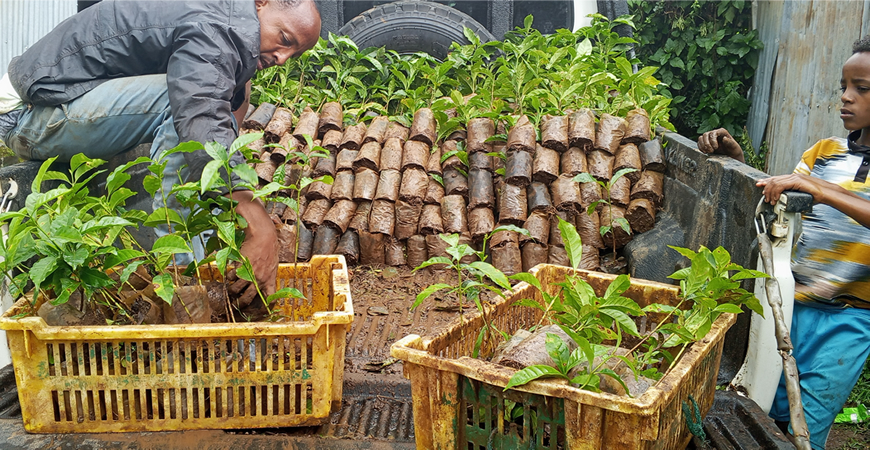
Coffee seedling distribution as one of the project’s core interventions, supporting climate-resilient livelihoods and strengthening household income through sustainable agricultural practices.
In Asagret, Ambo and Toke Kutaye districts of Amhara and Oromia Regions of Ethiopia Ethiopia, poor women, farmers and youth face persistent challenges of food insecurity, limited water access for agriculture, and climate-induced shocks that exacerbate poverty and reduce nutritional outcomes. Since January 2022, Enhanced Rural Self-Help Association (ERSHA) an Ethiopia Nile Discourse Forum (EthNDF) member has been implementing an Agro-ecology, Child-focused Development and Sustainable Food System project that is transforming lives through practical, sustainable interventions. - This is a story of resilience, women's empowerment, and climate-smart rural transformation
Since its establishment in 1997, ERSHA has been contributing to improved household income, poverty reduction, women empowerment, environmental protection, and the well-being of socially and economically excluded community groups in Ethiopia. They initiated a project in January 2022 aiming to enhance household income, reduce vulnerability, improve food security, and contribute to environmental restoration targeting 3,100 households (1,400 male-headed and 1,700 female-headed) across Amhara and Oromia Regions with integrated solutions that address both immediate needs and long-term resilience.
The Challenge: Overlapping Rural Vulnerabilities
Communities in the project areas were navigating compounded crises; unpredictable rainfall and prolonged dry spells, degraded soils and declining agricultural productivity, limited access to small-scale irrigation, dependence on single-crop farming systems, restricted economic opportunities for women and youth, and poor dietary diversity affecting children’s nutrition. These constraints reinforced cycles of vulnerability, leaving households exposed to climate shocks and market instability.
ERSHA’s Integrated, Multi-Pronged Approach
To break this cycle, ERSHA implemented a comprehensive package of interventions designed to diversify incomes, enhance food systems, and restore environmental health. The interventions include support for shoats (sheep and goats) on a revolving scheme, training on nutritious food preparation, provision of improved crop seeds, development of small-scale irrigation schemes, vermin composting training, vegetable seed distribution, agro-ecology-based environment protection, Enset (false banana) processing technology training, fruit tree plantation, and landscape greening initiatives.
By combining climate-smart agriculture, livelihood diversification, and nutrition-focused programming, the project addresses resilience at household, community, and ecosystem levels
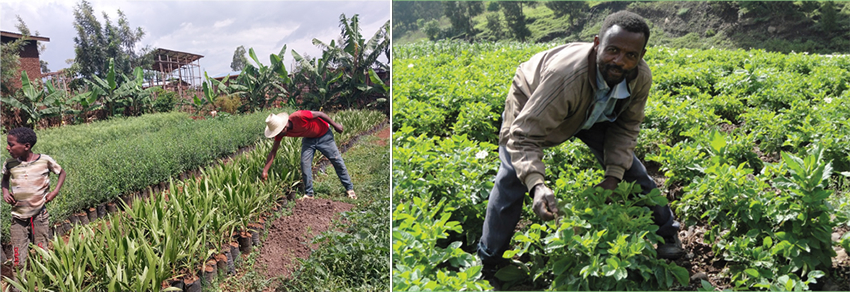
Tree seedling production by Youths (left) and Potato production using irrigation farming (right)
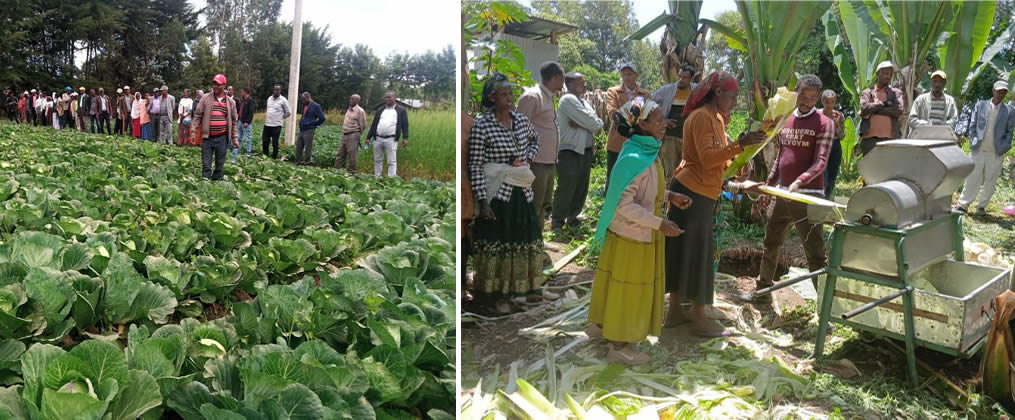
Vegetable production using vermicompost at Guder (left) and Enset food processing technology (right).
Tangible Results: Productivity, Inclusion, and Diversification
The outcomes speak for themselves. Agricultural productivity has improved significantly through irrigation and climate-smart practices, with beneficiaries reporting higher production in seasons where ERSHA supported small-scale irrigation interventions. Households have moved from dependence on single crops to diversified activities combining crops, small businesses, and livestock drastically reducing vulnerability to climate shocks. Farmer groups have been strengthened with improved market linkages, while women and youth now enjoy greater inclusion through economic participation and household decision-making over income. Households that once relied on rain-fed monocropping now operate diversified, climate-adaptive livelihood systems.
A Model That Multiplies: The Sheep Fattening Success Story
In 2024, ERSHA's sheep fattening initiative in Mutulu Kebele (Toke Kutaye Woreda) demonstrated the power of well-designed, women-centered interventions. Seven women received 14 sheep (two per woman) to start a fattening business. The timing was strategic; Ethiopia has over 13 public holidays annually when sheep are in high demand for celebratory slaughter, providing a reliable and profitable market.
Each woman fattened her sheep for one year while participating in training on animal husbandry, feeding, and small business management. They also contributed 100 ETB ($1 USD) per month to a group savings scheme totaling 1,200 ETB ($11 USD) annually per woman, or 16,800 ETB ($155 USD) collectively.
The numbers tell a remarkable story of sustainability. By year's end, each woman repaid an average of 12,000 ETB ($110 USD), bringing total repayment to 84,000 ETB ($778 USD). These funds purchased 14 additional sheep for a second group of beneficiaries in 2025. First-level beneficiaries not only repaid their loans but also reinvested in their own livestock by purchasing more sheep. In May 2026, a third group of women is set to receive sheep, continuing the revolving benefit system without requiring additional external resources.
The revolving structure ensures that impact compounds over time, transforming a single intervention into a self-sustaining enterprise model
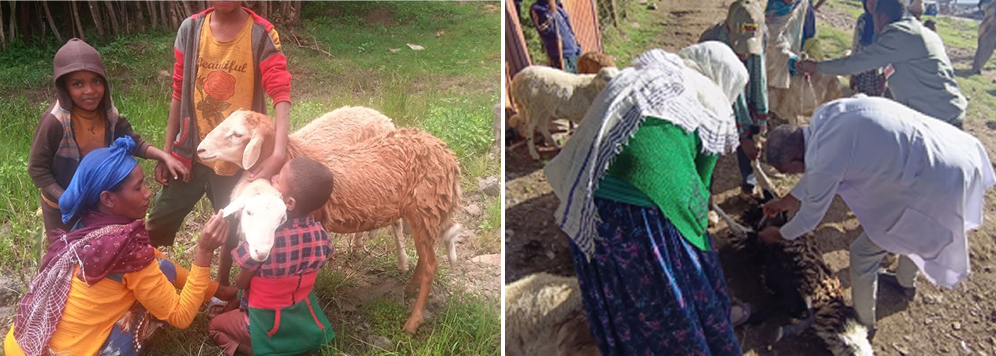
One of the beneficiary families with their sheep(left),Vaccination of sheep to avoid economic losses(right)
Key Lessons for Scaling Impact
The sheep fattening initiative illustrates a core development principle: when revolving capital, technical training, and market timing align, interventions evolve from short-term aid into scalable economic systems. Most importantly, women transitioned from beneficiaries to entrepreneurs, gaining practical skills, financial literacy, and economic agency.
Sustainable development emerges when communities are equipped not only with resources, but with the knowledge, structure, and ownership required to shape their own futures.
About ERSHA:
The Enhanced Rural Self-Help Association is a long-standing civil society organization in Ethiopia dedicated to poverty reduction, women’s empowerment, environmental protection, and inclusive rural development.
Share :

Related Stories
Key Resources
Author bio