NBD, throughout the accounting year, focused on implementing activities towards its three components that are stipulated under the Cooperation in International Waters in Africa (CIWA) Grant TF015834, (AF). The title of the Project is "Engaging Civil Society for Social and Climate Resilience in the Nile Basin'. This is the Additional Financing (AF) third phase of the project running from January 2020 to December 2021. The three components are as follows: (1) Component 1: Strengthening the NBD Secretariat, (2) Component 2: Improved Communication and Outreach, (3) Component 3: Capacity building for NBD members.
Project management is mainly by the NBD Secretariat with supervision and guidance from the 13 member NBD Board. The NBD Secretariat also receives closer supervision from the 4-member Executive Committee (EC) consisting of the Board Chairperson, Vice Chairperson, Treasurer and Secretary General. They hold meetings aimed at giving guidance to the Secretariat and the entire NBD Network of networks. The Secretariat also benefits from supervision missions and guidance by the CIWA/WB team led by the Project’s Task Team Leader (TTL), to discuss on the general progress and performance of activity indicators and programmatically guide on the strategic direction and engagement as stipulated in the Project Appraisal Document (PAD).
The project has been recognized by local Government Authorities and the community as one of the most promising fish farming projects in Mwanza and consequently many groups and individuals organize exchange visits to learn and be inspired. Currently, 1,208 people have visited the project site and 301 among them established their own fish ponds in Magu District alone.
Background:
The East African Communities Organization for Management of Lake Victoria Resources (ECOVIC) is a regional organization registered in Tanzania with regional and Tanzania chapter head offices at Capri-point, Mwanza Tanzania. The organization was formed to address the escalating problems in the Victoria Basin including natural resources depletion, poverty, and HIV/AIDS pandemic. ECOVIC Tanzania (ECOVIC Tz.) chapter is an active member of the Nile Basin Discourse (NBD); subscribing through Tanzania Nile Discourse Forum (TNDF).
Since its establishment, ECOVIC Tz. has executed various programs including Capacity building to Beach Management Units, training exchange program with Folk Development College of Sweden, tree planting programs, and hosting the Nile Basin Initiative’s Micro Grants Program. It is from this base that ECOVIC became a member of Tanzania Nile Discourse Forum.
Fish farming project for PLHIV and people affected by drug abuse:
This project is being implemented by ECOVIC Tz. chapter in collaboration with local community support groups with funding from UNDP since 2014. The project is addressing four thematic areas including income generation, nutrition, environmental conservation, support for PLHIV/AIDS, and fighting drugs abuse in fishing communities.
The project supports vulnerable people from three groups:
Tupendane PLHIV group from Magu District - with 27 members who are mostly women;
Wachapakazi group of 14 people affected by drugs abuse at Kigangama village of Magu District; and
Kitongo and Pambazuko village group in Namagondo Ward of Ukerewe District reaching 21 people.
The communities from Kigangama, Kitongo and Namagondo villages largely depend on fishing activities as the major source of income.
Implementation of the project:
The project has supported the establishment of 41 fish ponds; 7 for Tupendane group at Kigangama village, 12 for Wachapakazi groups at Kitongo village and 22 for Pambazuko group at Namagondo village.
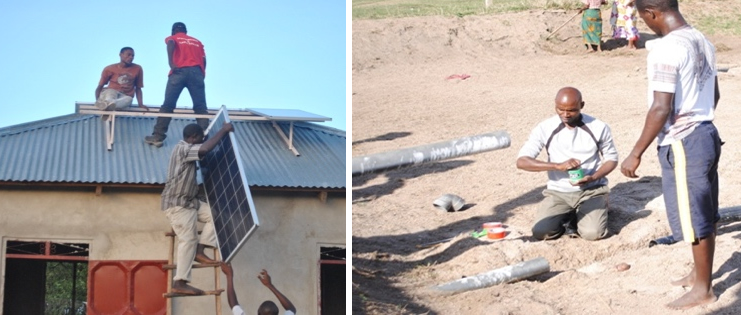
Fixing solar panels on the roof of project store (L), and Fixing pond inlet and outlet system (R)
ECOVIC Tz. has futher collaborated with Charity and other stakeholders to consolidate Tupendane Fish farming project for self -sufficiency. Under this consolidation the activities carried out included:
Installation of pond liners into ponds to hold water and prevent excessive water loss through overflow.
Renovation of water outlet and inlets structures of fish ponds using a cut in the dyke and pipes as method and types respectively.
Installation of solar lighting infrastructure to support the production process. Solar lighting is safe, clean, and cheap. Its installation at the farm sets an example to the community to embrace solar energy since it is environmentally friendly.
Installation of water tanks to simplify gravity filling of water into ponds for aeration. The system has two tanks; a filter tank, and a storage tank. The solar system generates power for the machine which pumps water from the lake into a constructed well, then further into the filter tank and lastly into the storage tank.
Purchase of water quality testing kit for monitoring water quality aspects including temperature, pH, oxygen concentration, salinity and turbidity.
Purchase of complete aqua-feeds plant comprising of milling, grinding and mixer machines to ensure aqua-feeds availability and income stability at the farm.
Success Stories:
The project has provided a number of tangible benefits to families and communities at large:
Generation of additional income from fish sales which is used to improve household livelihoods in numerous ways including payment for antiretroviral treatment, school fees, housing, and purchase of basic household items.
Improved nutrition - HIV/AIDS and drug abuse affected communities need quality nutrition, the project has successfully ensured that all beneficiaries get valuable protein through fish at family meals.
Community infrastructure development - Tupendane group has constructed their own office block which is also used as a training centre - not only for the group but also for events covering the entire village and ward.
The project has been recognized by local Government Authorities and the community as one of the most promising fish farming projects in Mwanza and consequently many groups and individuals organize exchange visits to learn and be inspired. Currently, 1,208 people have visited the project site and 301 among them established their own fish ponds in Magu District.
Challenges Encountered:
Increased installation costs for ponds vs the budgeted costs due to various challenges including: Limited accessibility to clay soil for covering pond liners – areas around the farm are sandy; wrong season timing for installation of pond liners which led to extra costs during the rainy season; the rocky geology of the pond area required extra cushioning of liners to protect them from being punctured by rocks; and price fluctuation for some project materials which increased the project cost.
Increased demand for fish feeds due to fish farming mushrooming in the lake zone and competition for feeds particularly with livestock keeping projects.
Ponds leakage and high energy consumption - Project sites rely on pump-fed ponds using costly fossil fuel in the production process with high consumption during the dry season.
Conclusion:
Fisherfolk around Lake Victoria often land fish in markets away from home where cash-in-the-pocket is easily spent on alcohol and transactional sex. As HIV/AIDS robbed rural households of income earners and agricultural labour, many households are turning to natural resources as a safety net. Activities such as illegal fishing and charcoal burning increase as families seek alternative livelihood strategies. More water, firewood and medicinal plants are required by households in the struggle to care for the sick.
Despite the dire circumstances, efforts by the Government of Tanzania collaborating with ECOVIC and other stakeholders to alleviate the impacts of HIV and drug abuse in the communities around Lake Victoria Basin through this project is timely. Stakeholders are in dialogue on how to sustain the interventions.
Authors: Jackson Ndobeji, ECOVIC Tanzania Chapter Hadija Malimusi, National Technical Support Expert - Tanzania NDF
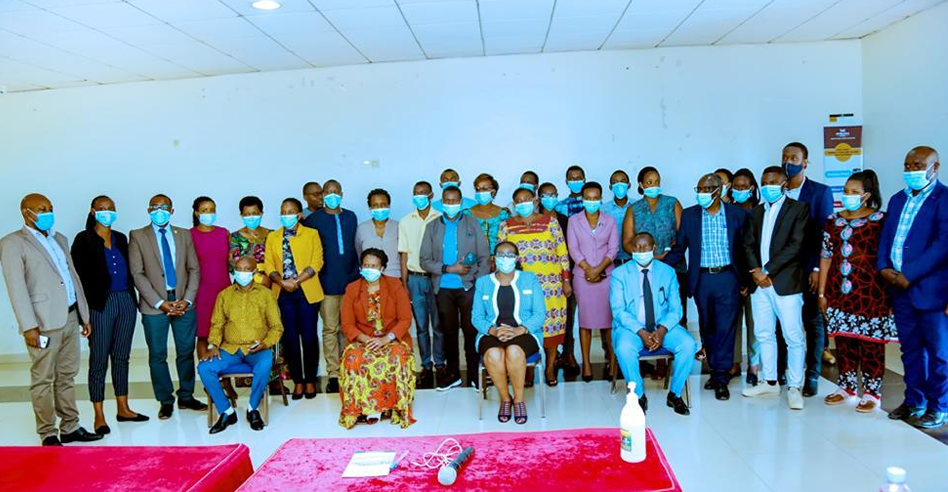
Every year, Nile Basin Discourse Forum (NBDF) Rwanda holds a General Assembly (GA) meeting for its membership. This year’s AGM was held on the 17th August 2021 at Nobleza Hotel in kicukiro, Kigali; with 45 out of 47 member organisations in attendance.
In the capacity of the Guest of Honour, the assemby was graced by the Nile Technical Advisory Committee (Nile-TAC) member for Rwanda Ms. Jacqueline Nyirakamana who is also the Chair of the Regional Nile-TAC.
The roles of the General Assembly as elaborated in the organisation’s constitution are: to approve organisation’s policies, plans, budgets and reports and with far reaching objectives of re-energizing NBDF’s performance; reviewing of the annual narrative and financial reports; reviewing existing policies and proposing of new desired organizational policies.
The board chairperson Ms Verdiane Nyiramana updated the GA on the current status of the organization; first with the changes that have been made at the secretariat since 2018 when the previous Coordinator left. She highlighted the progress for the revival of NBDF Rwanda and the commitment of the Board of Directors towards the growth of the forum. She emphasised that there is hope for having a strong NBDF Rwanda going forward and thanked the commitment from both the Coordinator and the Board Members.
The GA reviewed the Annual Report 2020 which notably took a short time since a few activities were implemented in that year because of the Covid-19 pandemic and the associated lock-down that greatly hampered the organisation’s activities.
The Guest of Honour expressed gratitude for the invitation to officiate at the GA and recognized the good partnership between the Ministry of Environment and NBDF Rwanda. The Nile-TAC chair highlighted the available opportunities for Nile Basin Discourse in general, including the Nile Cooperation for Climate Resilience (NCCR) Project in which the NBD Regional body has been allocated funds for stakeholder engagement from which NBDF Rwanda can benefit. She emphasized a few points: cooperation among member organizations; to continue producing the Intervention Report of Civil Societies; and to align NBDF Rwanda activities with the Ministry of Environment objectives.
123456
The GA elected Dr Safari Emmanuel as the new Board Vice Chairperson, filling up a position that has been vacant for a while. Dr Safari has been the Legal Advisor to the Board, a post he will still hold until the Board identifies another befitting individual within the network to take on the responsibility. The GA appreciated the NBDF Secretariat for what they were able to accomplish amidst the tough funding challenges and encouraged the coordinator to put more focus on resources mobilization going forward.
The assebly equally thanked the NBDF Board for providing oversight to the NBDF secretariat and tasked the Chairperson to continue working hand-in-hand with the coordinator, providing support until the secretariat is well strengthened.
The Assembly applauded the role of the NBD Regional Secretariat in Uganda for supporting NBDF-Rwanda and requested it to continue doing so and opening of more opportunities for joint projects.
Overall, this year’s GA was a success; the attendance of members was quite satisfactory and the forum leadership was able to pleasingly give accountability to the NBDF membership.
Author: UWAMAHORO Lydia National Technical Support Expert – Rwanda NDF